Raised Outdoors. Not Indoors.

Greener Pastures Chicken is pasture-raised on open land - not confined to indoor barns, cages, or crates.
Our birds live outside, rotated each day on real pasture, under natural sunlight.
This is how chicken is meant to be raised.


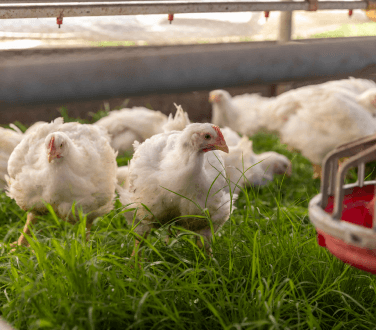
How we Raise our Birds.
Outdoor Living. Real Pasture.
• Live primarily outdoors
• Rotated on fresh grass
• Natural sunlight and fresh air
• Space to roam, forage, and move
We raise slower-growing breeds with room to behave naturally. No shortcuts. No confinement model. Just pasture.
• Live primarily outdoors
• Rotated on fresh grass
• Natural sunlight and fresh air
• Space to roam, forage, and move
We raise slower-growing breeds with room to behave naturally. No shortcuts. No confinement model. Just pasture.
How most chicken is raised.
Not all labels are created equal. And most chicken in the U.S. is raised indoors. What that means:
• Large enclosed barns
• High stocking density
• Artificial lighting cycles
• Some to no meaningful outdoor access
• Spaces and conditions vary wildly
If it doesn’t live outside most of its life, it isn’t pasture-raised. We believe chickens should live like chickens. How a bird lives affects the food it becomes.
• Large enclosed barns
• High stocking density
• Artificial lighting cycles
• Some to no meaningful outdoor access
• Spaces and conditions vary wildly
If it doesn’t live outside most of its life, it isn’t pasture-raised. We believe chickens should live like chickens. How a bird lives affects the food it becomes.


Independently Tested. Nutrient Dense.
Better living conditions create better food.
• Higher Protein Count
• Lower total fat
• Significantly higher antioxidants
• Higher Vitamin A
• Strong B-vitamin profile (B3, B9, B12)
• Higher Protein Count
• Lower total fat
• Significantly higher antioxidants
• Higher Vitamin A
• Strong B-vitamin profile (B3, B9, B12)
Why that difference matters.
Outdoor pasture-raised birds experience space to roam, scratch, forage, eat bugs, by primarily living outdoors
That shows up in:
• Lower stress environments
• Lean, clean protein
• Lower total fat
• Higher antioxidants
• Higher Vitamin A
• Strong B-vitamin profile
Better environment → Better bird → Better nutrition.
That shows up in:
• Lower stress environments
• Lean, clean protein
• Lower total fat
• Higher antioxidants
• Higher Vitamin A
• Strong B-vitamin profile
Better environment → Better bird → Better nutrition.

Access to pastures and forage diversity contribute to a happy, healthy, and more nutrient-dense bird.
You can taste the difference - and measure it.

Higher Protein Count

Lower Fat Content

Higher Antioxidant Count

Higher in Vitamin A

Higher in Vitamin B3

Higher in Vitamin B7
Shop Our Most Requested Products
Select products to feature in this block
FAQs
How much time do the birds spend on the pasture?
Our birds live the first 3 weeks of their lives in the brooder so they can develop their feathers to better regulate their own body temperature. As soon as they are ready, they move out to the pasture for the remainder of their lives where they can run around in the grass and forage freely.
What kind of nutrients make up the supplemental, organic feed?
Their certified organic feed can include any of the following ingredients: soy, corn, sorghum, sunflower, alfalfa, vitamins, and trace minerals.
How often are the birds moved?
They’re moved to a new section of pasture every day!
What is the major differentiator between our birds and the standard American chicken?
The active outdoor lifestyle of our birds, in tandem with our certified organic feed and certified organic pasture, leads to a happier, healthier, and tastier chicken as opposed to confined animal feeding operations (CAFOs) that make up over 99% of chicken sold in the U.S. food system.
What is regenerative about our farm?
Healthy birds start with healthy soil. Microorganisms, with the help of sunshine and clean water, help break down chicken manure into vital nutrients that feed the soil biology. When the chickens move back to the renourished section of land, the chickens then reap the benefits by consuming the nutrient-rich grasses. Our rotational grazing system adds more organic matter to the soil and leaves healthier grassland behind over time.
What kind of animal welfare standards do you uphold?
One of our many certifications is the Certified Humane certification. We’re proud to offer our birds a superior lifestyle that is free from stress.
Do your birds receive any antibiotics or hormones?
Our birds are never raised with antibiotics or hormones.
Do you feed your chickens corn or soy?
We feed USDA Certified Organic and Non-GMO Project Verified corn and soy as part of a much more diverse feedstock to our chickens to ensure their baseline nutritional needs are met. In addition to their feed, our chickens supplement their diets with native pasture grasses, bugs, and grit. We prioritize their supplemental diets by moving the birds to fresh pasture every day. Our farm and feed ingredients are never sprayed with harmful pesticides, herbicides, or desiccants like that of their conventional, "natural," and strictly "Non-GMO" counterparts.
How do we know the birds are living happy lives?
We’re proud to hold the most certifications in the industry: USDA Organic, Real Organic Project, Regenerative Organic Certified, Non-GMO Project Verified, GoTexan, and Certified Humane. These certifications require strenuous adherence to guidelines and standards that our farm team works 365 days a year to meet!
How do we know the birds are living happy lives?
We’re proud to hold the most certifications in the industry: USDA Organic, Real Organic Project, Regenerative Organic Certified, Non-GMO Project Verified, GoTexan, and Certified Humane. These certifications require strenuous adherence to guidelines and standards that our farm team works 365 days a year to meet!